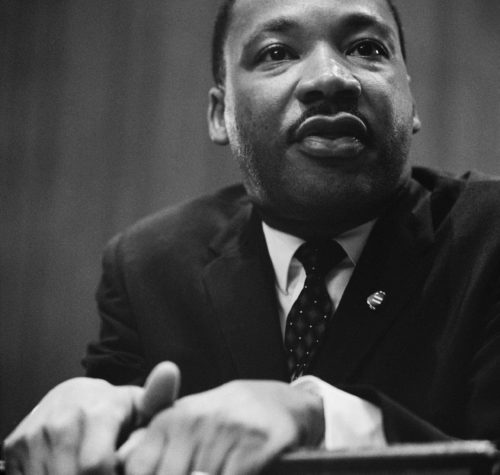
Born on January 15, 1929, in Atlanta, GA, Martin Luther King, Jr. was an American Baptist minister and civil rights activist. During the less than 13 years of Dr. Martin Luther King, Jr.’s leadership of the modern American Civil Rights Movement, he helped African Americans achieve more progress toward racial equality than the previous 350 years had produced. Dr. King is widely regarded as America’s most widely known advocate for nonviolent activism. Drawing inspiration from both his Christian faith and the peaceful teachings of Mahatma Gandhi, Dr. King led a nonviolent movement in the late 1950’s and ‘60s to achieve legal equality for African-Americans in the United States. While others were advocating for freedom by “any means necessary,” Dr. King used the power of words and acts of nonviolent resistance, such as protests, grassroots organizing, and civil disobedience to achieve civil rights goals.
In 1955, he was recruited to serve as spokesman for the Montgomery Bus Boycott, which was a campaign by the African-American population of Montgomery, Alabama to force integration of the city’s bus lines. In 1957, Dr. King was elected president of the Southern Christian Leadership Conference (SCLC), an organization designed to provide new leadership for the now burgeoning civil rights movement. In 1963, he led a coalition of numerous civil rights groups in a nonviolent campaign aimed at Birmingham, Alabama, which at the time was the “most segregated city in America.” Later in 1963, Dr. King was one of the driving forces behind the March for Jobs and Freedom, more commonly known as the “March on Washington.” It was at this march that Dr. King delivered his famous “I Have a Dream” speech.
After that speech, King’s work was impossible to ignore. In 1964, at 35 years old, Martin Luther King, Jr. became the youngest person to win the Nobel Peace Prize. Dr. King’s work started to directly impact national legislation. Dr. King’s March on Washington pushed Congress to pass the Civil Rights Act in 1964, and the Selma to Montgomery March for Voting Rights led to the passing of the Voting Rights Act of 1965. Between 1965 and 1968, Dr. King shifted his focus toward economic justice and international peace. His work in these years culminated in the “Poor People’s Campaign,” which was a broad effort to assemble a multiracial coalition of impoverished Americans who would advocate for economic change. During this time, J. Edgar Hoover of the FBI designated King as a radical, subjecting him to investigation and harassment from the COINTELPRO program.
Dr. Martin Luther King, Jr.’s nonviolent leadership ended abruptly and tragically on April 4th, 1968, when he was assassinated in Memphis, Tennessee. His untimely death was followed by riots in many U.S. cities. Dr. King’s body was returned to his hometown of Atlanta, Georgia. His accomplishments are now taught to American children of all races, and his teachings are studied by scholars and students worldwide. He is memorialized in hundreds of statues, parks, and other public facilities around the world as a leader whose teachings are irrevocably tied to the progress of civil rights.
Do you, your classroom, or your group want to make your own chair? We have many resources that lead you through the activity!
And don’t forget to come back to submit photos of your chair for a chance to be featured on the website.

The “A Seat at the Table” exhibit was made possible by the generous support of the Fund II Foundation.

The Edward M. Kennedy Institute for the United States Senate is dedicated to educating the public about the important role of the Senate in our government, encouraging participatory democracy, invigorating civil discourse, and inspiring the next generation of citizens and leaders to engage in the civic life of their communities.